Discover Things to Do in Rome in 2017

The Italian capital has a busy events calendar, here are some of the best things to do in Rome in 2017!

From sporting events and annual cultural festivals to street performances and more, Rome is a fun-filled capital that never seems to stop buzzing! Check out some of the best things to do in Rome this year, with our comprehensive guide to the city's favourite events! If you happen to be in town during these events, be sure to mark your calendar because you won't want to miss them!

Rome Marathon

As one of the biggest sporting events of the year, the Rome Marathon attracts runners and spectators from all over the world. With a 42 kilometer run for serious runners and a 5km Roma Fun Run for casual joggers, there's also a number of fun activities happening at the Marathon Villages. Runners will race past iconic landmarks like the Trevi Fountain, Spanish Steps and St Peter's Basilica and be able to squeeze in some sightseeing while achieving their personal best times. Dates: 2 April

Natalie di Roma

Happy birthday to Rome! This vibrant celebration honours the founding of Rome in 753 BC, which is said to have been the work of the twins Romulus and Remus for which the capital is named. All day, re-enactments of their story, fireworks and parades brighten up the streets (especially around Campidoglio) and fills the city with a festive atmosphere. Dates: 21 April

Festa de'Noantri

Held in the Trastevere neighbourhood, this holiday celebrates the discovery of a Madonna statue during a storm by fishermen. The cedarwood statue was then donated to the church St Agata and during the Festa de'Noantri, it is taken and carried to the larger St Tiber church in a beautiful religious procession. After eight days, it is returned to St Agata by boat. As with any great Roman festival, music, dancing and theatrical performances characterise the neighbourhood's joyful transformation. Dates: 18 July

Papa Audiences at St Peter's Basilica

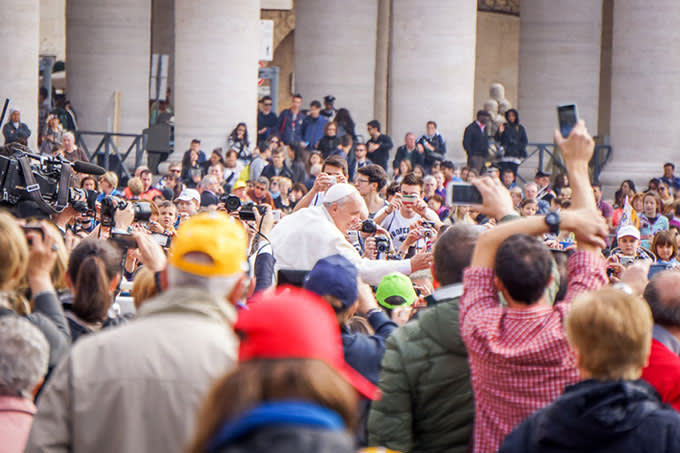
See the Pope at some of the Vatican City's public masses and audiences, held famously at St Peter's Basilica where the papal throne is housed. The Pope regularly conducts the Angelus prayer from his window in the basilica and anybody can watch him speak from the square, however it is worth arriving early to save a good spot. For traditional masses, visitors will have to secure tickets to enter the basilica which are all free of charge. When you've finished, spend some time exploring the basilica and its historical tombs - it's one of the best things to do in the Vatican City. Dates: See the full 2017 papal calendar here.
Settimanta Santa and Pasqua at the Vatican City and Colosseum

Easter is a hallowed time for the Vatican, with numerous services and celebrations held all week long. One of the most important Catholic traditions is Good Friday's Via Crucis - the Stations of the Cross - which is a procession that re-enacts Jesus Christ's struggle to carry his crucifix to his place of death. The procession begins early in the morning at the Colosseum where a prayer is recited, then winds through Vatican city to thirteen additional stations such as St Peter's Basilica before finishing with a public mass at the Colosseum. Make sure to return to the Colosseum on a quieter day to wander its crumbling tiers and learn about its gladiatorial past through its fascinating exhibition. Dates: March/April

Festival della Letterature

The Roman Forum is a must-visit for any Rome traveller with stunning relics dating back to ancient times held within its halls. Aside from celebrating Rome's ancient culture, it also honours the best that Rome's modern literary scene has to offer at the Festival della Literature. This popular cultural festival is held annually at the atmospheric Basilica of Maxentius over a number of days, featuring readings by internationally renowned writers such as Zadie Smith, William Finnegan and more. It works a little differently than other literature events - a theme for the festival is announced and then writers create something that pertains to that theme, which are then read aloud. Dates: To be announced, usually May/June

Sistine Chapel and the Vatican Museums

While this isn't an event per se, the Sistine Chapel and the Vatican Museums' stunning artistic collection are the pinnacle of Roman culture and not to be missed. Open all year round, the Sistine Chapel is most notably famed for Michelangelo's The Last Judgment which arcs across its ceiling and the Vatican Museums for Botticelli's frescoes. Visitors are required to book tickets in advance. Dates: Open year round

Gay Village

A ten-week open-air bonanza that makes summer the pinkest season of the year: bars, restaurants, live acts, discos, cinema – a great place for boys and girls alike. Venue and contact details change from year to year, but the website reveals all as the date approaches. Where: venue changes from year to year Dates: late June-early Sept 7pm-3am daily

Festa de Noant ri

Though few traces of Trastevere's working-class roots remain today, the area's residents celebrate its humble origins with gusto during the Festa de' Noantri. Festivities kick off with a procession held in honour of the Madonna del Carmine, to whom the whole shebang is theoretically dedicated. Two weeks of arts events and street performances follow, and fireworks round off the closing night. Where: Piazza Santa Maria in Trastevere/piazza Mastai Dates mid-end July
Go City Expert
Rome Travel Expert

Continue reading

Blog

A Roman run-up to Christmas

When we think of Christmas evening activities carol singing, mulled wine and German Markets spring to mind. However, you wouldn’t usually associate any of those with Italian culture. So what do the Romans do for a winter’s evening in the run-up to Christmas? Rome is a magical place during the festive period; the strong Catholic beliefs as well as a westernised celebration of the season means the city is engulfed in the lights of church candles, smells of roasting chestnuts and the chatter of bustling shoppers. The Eternal City offers some unique experiences come the colder months, and especially at Christmas time, that are nothing short of bucket-list-worthy. So if you’ve already done your shopping and fancy something a little different, follow our evening itinerary for an insider’s alternative to celebrating in the capital. 1. Admire the views from Pincio Stand at the Pincio in Villa Borghese, the viewpoint at the top of the main steps into the city’s central park, and take in the views of the city at nightfall. As the sun goes down, you can watch the terracotta rooftops of the capital fade away under a warm glow of Christmas lights. To your left you can look all the way up the main shopping street Via del Corso, to the grand Piazza Venezia where the impressive Vittorio Emmanuele II monument stands, and to the west you can see Piazza del Popolo and the Egyptian obelisk of Ramesses. You can even see the great dome of Saint Peter’s Basilica away in the distance. 2. Ice Skating at Castel Sant’angelo Take a walk across the ancient engraved bridges over the river Tiber and hire some skates under Castel Sant’angelo for a spot of atmospheric ice skating. The large round castle was built by the Emperor Hadrian initially as a mausoleum for him and his family but in later years it was used as a fortress and even a prison and today it stands as a museum. Lit up at night, the castle is a spectacular sight – and if you’re lucky, you can catch a show or a figure skating performance on the ice as well. 3. Christmas in Saint Peter’s Stroll along the Lungotevere, the northern bank of the river, under the arch of trees and up to Piazza San Pietro (Saint Peter’s Square) to see the tall, illuminated Christmas tree outside the church. Pope John Paul II brought over the northern European tradition from his native homeland when he was pontificated in 1982. If you’re in Rome on Christmas Eve, you can even catch the unveiling of the nativity scene in the square, too. As well as being a picture-perfect opportunity, it gives you another reason to visit the iconic monument in all its glory. 4. Be a local in Trastevere Explore your way through the cobbled streets of Trastevere (which literally translated means across the Tiber) for a warming glass of wine and a slice of oven baked pizza. The area has numerous star-rated options so you won’t be left disappointed – and you’re guaranteed to be served with a smile! If you need to walk off your dinner, brave the winding Via Garibaldi to get to Gianicolo (Janiculum Hill) for breathtaking views across the city. On your way up, look through the gate on the right of the church for a Renaissance masterpiece, The Tempietto, designed by Bramante. 5. Celestial chanting at Sant’Anselmo all’Aventino For something a little different, walk up the Aventine hill to hear some celestial Gregorian chants at the 7.15pm Sunday service at Sant’Anselmo church. This church serves as a monastery and college and is seat to the Abbot Primate of the Order of Saint Benedict (Black Monks). It’s not your usual yuletide carol singing, but a must-do to finish off your trip in spiritual style.
Go City Expert
Blog

Visiting the famous Trevi Fountain - Top Tips

An enduring icon of the Italian capital, the Trevi Fountain is a breathtaking piece of art that attracts millions to its waters every year. Learn more below... If you’re planning a visit to Rome, chances are you’ve been inspired by many Hollywood films set here: Roman Holiday, La Dolce Vita and even The Lizzie McGuire Film if you’re a millennial. One thing all these three films have in common is that they all feature the most famous fountain in Rome, the Trevi Fountain. Trevi Fountain Rome History Dating all the way back to 19BC, this Rome water fountain is known to locals as Fontana di Trevi and persists as one of the capital’s most photographed sights. As a stunning example of Baroque art and architecture, it actually was created with a pragmatic purpose in mind - to round off an aqueduct and bring water to the townspeople. Nowadays however, it’s one of Rome’s biggest tourist draws and is always surrounded by people throwing coins into its depths. Constructed by Roman architect Nicola Salvi and completed by Giuseppe Pannini, this Rome fountain pays homage to ancient Roman mythology with the god of the sea Neptune at its centre. Standing astride a shell chariot led by sea horses and flanked by allegorical statues of Abundance and Salubrity, it took nearly three centuries to complete and has changed over the years. However, the Rome Trevi Fountain has never looked better following a recent €2.2 million restoration process. Trevi Fountain Location If all roads lead to Rome, then most roads in Rome lead to the Trevi Fountain. Located in the heart of the city nearby the Via Del Tritone, it sits proudly in the centre of Piazza di Trevi. Easily accessible from the Barberini Metro station, it’s also just a few steps from another famous Roman sight: the Spanish Steps. Best time to visit the Trevi Fountain As one of Rome’s most popular attractions, the Trevi Fountain is always packed with people daily. For budding photographers seeking an emptier shot and those leery of crowds, it’s best to head here early in the morning to see it in daylight. The Rome fountain completely changes at night, when lights are switched on to illuminate the ivory sculptures for a totally different and atmospheric experience. Wander here after dinner when the crowds have abated for a unique experience after the rest of the tourist pack have retired to their hotels for the night. Attractions nearby the Trevi Fountain As one of the most centrally located attractions in Rome, the Trevi Fountain is within walking distance of many iconic landmarks in the capital. The Spanish Steps are the closest by alongside Villa Borghese and its famous gallery a little further along in that direction, while the heading in the opposite direction will take you towards the Pantheon and even the Roman Forum if you’re up for a bit of a walk. Trevi Fountain Legend If you’re heading to Trevi Fountain, remember to bring some change. The most popular legend surrounding this famous fountain in Rome dates all the way back to ancient times, granting travellers to the city a safe return to the capital. It’s said that if you turn your back to the fountain and throw a coin with your right hand over your left shoulder, you will be certain to return to Rome in the future. Chances are you’ll spot lots of other tourists doing the same thing and to be honest, who doesn’t want to come back to Rome? Fans of the film Three Coins in the Trevi Fountain may already be aware of the other legend surrounding the fountain, which also builds on the coin-throwing practice. As the title of the film suggests, visitors should throw three coins into the fountain as the first guarantees safe passage, the second a new romance and the third a successful marriage. Even if you’re not particularly superstitious, participating in the harmless tradition of throwing a coin into the fountain actually helps the city. The money from the fountain is collected daily and it is said 3000 Euros are thrown in a day, with proceeds going towards charities that help people in need.
Megan Hills
Blog

Eat and drink like a local: the best bars and cafés in Rome

To truly experience any city, it’s best done like a local. It’s not always possible to find the best places to eat and drink in a guidebook so word of mouth and tip-offs from those who know is key. Like any capital city, Rome can be a bit of a tourist trap and without knowing about the best spots, eating and drinking out can be quite a costly expense and in the worst case, a disappointment. The best bars and cafes in Rome aren’t often that far off the beaten track, but sometimes it takes a little to know them. From where to find the best espresso, to the best pizza you can’t fail with our best places to eat and drink your way around Rome. Antica Birreria Peroni Via di San Marcello, 19 If you want to expand your satisfy your Peroni cravings then this bar is the one for you. Antica Birreria Peroni has been the watering whole of Roman locals for over 100 years, so it’s safe to say there’s a reason why it’s been going so long. A simple bar-come-restaurant it's tucked away just off the busy Via del Corso shopping street, down a cobbled alley, so think authentic and traditional. Try their specialities that fill the bar; Peroni Gran Riserva, Peroni Nastro Azzurro, Crystall Red - or even Fuller’s London Pride in case you get homesick. Il Goccetto Via dei Banchi Vecchi, 14 Dubbed Rome’s best wine bar, this unassuming nook is where you want to go for a taste of Italy’s fine wines. Literally, a hole in the wall, it’s housed in one of Rome’s oldest buildings which dates back to 1527. Selling over 800 different wines, it’s impossible to try them all but you can have a good go at it! With walls stacked with bottles – much like a library with its books – it’s the perfect place to go and rest your feet after a day of sightseeing. You can choose from a selection of cold meats and cheeses to accompany your wine; a great aperitivo before dinner. Caffé Greco Via dei Condotti, 86 Italians don’t do things in halves when it comes to the hard stuff. Famous for their strong coffees, tasting a true Roman espresso is top of the list. Head to the Antico Caffé Greco on the prestigious shopping street Via dei Condotti, and experience a real Roman coffee. In one of the oldest coffee shops in Rome it’s considered a historic landmark as it opened in 1760. Keep your eyes peeled for celebrities as it’s a hot spot for those in the know. Dar Poeta Vicolo del Bologna, 45/46 You might be sick of the sight of Pizza when leave Rome but you can’t go without having a seat at Dar Poeta first. Loved by locals, this Trastevere based pizzeria will whip up some of the most authentic flavours and serve up simple combinations that will leave you wanting more! From traditional tomato and mozzarella to Nutella calzone, there’s a range of options from sweet to savoury. Make sure you’ve got a big appetite because you’ll want to try it all. Gelateria Fatamorgana Via Roma Libera, 11 The USP of this ice-cream shop is that it’s all about the all-natural and no-additives. In a city that’s bursting with ice cream shops you want to get a good scoop. This chain of gelaterias can be found all around the city from near the Vatican to the Coliseum. Indulge in their hand-made combinations such as blueberry cheesecake, or even basil and black olives if you’re feeling adventurous. Ice-cream’s a great palate cleanser and with creamy options to light sorbets you’re bound to find something to suit your mood.
Go City Expert
The Colosseum, Roman Forum & Palatine Hill
Vatican Museums and Sistine Chapel - Fast Track & Reserved Entry

Dreaming of that Rome city break?

Sign up to receive top travel tips

Borghese Gallery
Hop-on Hop-off Bus Tour