Our Guide to the Street Markets in Rome

Published: July 17, 2024

When in Rome, do as the Romans and wander through one of the city's bustling Street Markets!

There are many wonderful markets in Rome, you’ll find one practically in every rioni (or district). Some have been trading for more than 400 years - others are more recent pop-ups. But regardless of their longevity, we guarantee that visiting markets in Rome is an excellent way to soak up the city’s unique atmosphere. To help you make your selection, we've put together a short guide to a few of our favourites. Our top tips? Listen out for some gentle banter, and don’t be afraid to haggle!

Porta Portese Market

Rome’s largest and most famous market (ideal for souvenir-hunting) Porta Portese Market is about a mile long and spills over into neighbouring backstreets. Endless stalls and traders in carpets, fabric, antiques, clothes and even pets provide endless happy hours of bargain-hunting. If you’re not keen on shopping, just soak up the vibrant atmosphere, but watch out for pickpockets! Open: Sun 5am-2pm

Borghetto Flaminio Market

This weekly market in Rome is a must-see for anyone in the area surrounding the Piazza del Popolo. It’s an ideal place to pick up rare antiques and designer clothing, and you’ll find some real bargains thanks to Rome’s glamorous and fashionable locals. Armani sunglasses, Gucci handbags and fur coats are just a few of the treats in store for you. Open: Sun 10am-7pm

Campo de Fiori

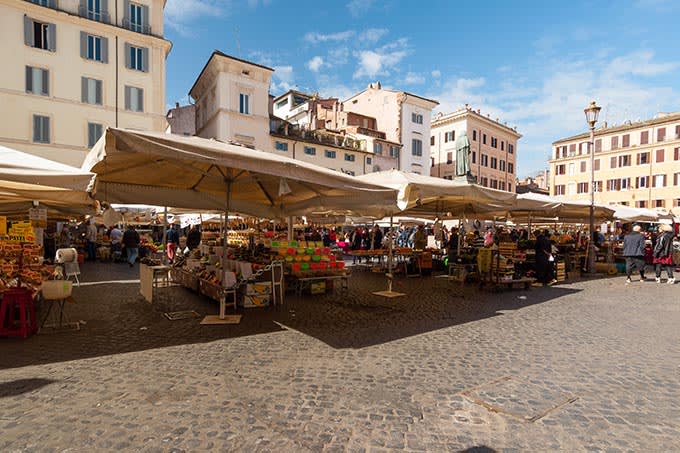
Rome’s oldest market, the Campo de Fiori farmers’ market, has been around for over 400 years. Although the name means ‘field of flowers’, there is in fact a wide range of products to buy here, including beautiful flowers, fresh fruit and vegetables, Italian meats and cheese, and local delicacies such as truffles and homemade olive oils. Probably not for you if you’re on vacation, but you can also get hold of kitchen utensils and various bits and pieces for the home. Open: daily
Fontanella Borghese Market

If you’re an art or literature lover, a trip to the Fontanella Borghese Market is a great opportunity to find ancient etchings and prints, as well as bargain books. This market is the perfect place to pick up antique maps, vintage posters, used cameras, old magazines and newspapers and exquisite art. A nice change from the regular tourist souvenirs on offer in Rome. Open: Mon-Sat 9am-7pm

La Soffitta Sotto I Portici Market

This market is a favourite with Rome’s young and trendy, who come to browse bric-a-brac and vintage. You can rifle through second-hand jewelry or clothing, and grab a real bargain if you’re in the market for silk scarves, crystal beads or antique lace. Located between the Spanish Steps and Piazza del Popolo, this market is in one of the most beautiful and historic parts of Rome. Open: 7am-7pm on the first and third Sundays of the month

Campagna Amica Market

This covered market is a good one for foodies. You’ll find the freshest fruit and vegetables in the city, locally sourced from Lazio farmers and the region surrounding Rome. Taste honey almost straight from the hive and olives practically just fallen off the trees! And support regional farmers and the local environment. Open: Sat-Sun 10.30am-7pm

Piazza San Cosimato Market (in Trastevere)

Known as the ‘Jewish Ghetto’, Trastevere is one of Rome’s most fascinating areas, with cobbled streets and peaceful hideaways. The origins of the market date back to the early 20th century and many of the vendors are descendants of the market’s very first traders. Regulars include a fishmonger, several butchers and plenty of fresh fruit and vegetable stands. Open: Mon-Sat 6am-1.30pm No trip is complete without a visit to one of these markets in Rome. Whether you’re an avid bargain hunter, a fierce haggler or a relaxed browser, these markets will give you a taste of Rome past and present - a sensation not to be missed. Happy shopping!

Go City Expert
Rome Travel Expert

Continue reading

Blog

Rome's top three museums for art and history

A visit to Rome is rich in culture, history and tradition. Any visitor will fall in love with the city and be overwhelmed by the deep running traditions and heritage of the Roman people. There’s no better place to experience this than by visiting the wealth of museums within Rome, accessible with your Roma Pass and OMNIA Card. Both cultural and historical, there are museums that exhibit the city’s artistic and social past. We thought we’d look at top three and share with you why they are must-sees: Vatican Museums Arguably the most famous museums in Rome, the Vatican Museums are a cultural pilgrimage as much as a religious one. Set in the Vatican City they are home to some of the most priceless art and sculptures in the world. This vast set of interconnecting museums measure over 9 miles, so you’re best to dedicate a good half day to exploring the departments and salas at leisure. Some of the highlights of the museum include the Papal Throne, the Sistine Chapel, and various galleries displaying ancient statues, busts, maps and tapestries. Its 1,400 rooms are brimming with art dating back from Ancient Egypt to the 20th century. So there’s something for everyone. Obviously there’s a deep spiritual undercurrent and theme behind all the works collected and on display in the Vatican Museums so visitors can learn about the Papal history and Roman Catholic influence over art works through the ages. Some of the artists featured in this renowned museum are Michelangelo – who’s Last Judgement can’t be missed – Raphael and Bernini, among others. National Museum of Castel Sant’Angelo This fortified castle, and mausoleum, is one of Rome’s most iconic landmarks and sits impressively on the northern bank of the River Tiber. The National Museum of Castel Sant’Angelo is a must-visit for anyone interested in history and is otherwise known as the Mausoleum of Hadrian. Interlinked with the Vatican – there’s a secret passage underground that links the two together once used for papal refuge – the museum of Castel Sant’Angelo is home to Papal apartments of the (infamous) Borgia Pope Alexander VI and display the lavish decorations and furniture collected by these heads of the Church. Visitors can also admire the Hall of Urns where it’s believed the ashes of Hadrian are kept, symbolically, right in the centre of the stronghold. Capitoline Museums Rome’s Capitoline Museums are some of the best collections of ancient Roman art and archaeology. Originally built as the ‘people’s museum’ it’s also believed to be the first museum in Rome – and the world’s oldest national museums – founded in 1471 by Pope Sixtus IV. One of the many highlights of the collection is Rome’s national symbol, the She Wolf and Romulus and Remus. The collections also contain ancient sculptures, statues, sarcophagi, mosaics and ruins of ancient dwellings from the Roman Forum. Set within three buildings, there is so much to be discovered about Rome’s rich history and culture – as well as Ancient Egyptian and Ancient Greek cultures. The Capitoline Museums give visitors a unique insight into Rome’s important history and you won’t be disappointed! With the Roma Pass you can get free entry into the Capitoline Museums and the Museum of Rome for free and many other historic sites like the Coliseum and the Roman Forum & Palatine Hill at a discounted price.
Go City Expert
Blog

Rome Itineraries - 3 and 4 days

Planning an itinerary is the best way to make the most out of your visit – especially to a city that has so much to see and do, like Rome. With your 3-day OMNIA Rome and Vatican Pass, here is a suggestion of what you could do over 3 days in Rome and if you’re staying a bit longer, what to do during day 4 in Rome, too. From the iconic historic attractions to must-do bus tours, here are some suggested itineraries for your trip to Rome. 3 Day Itinerary Day 1: MORNING Attraction: St Peter’s Basilica Make St Peter’s Basilica the first stop on your itinerary and get one ticked off the bucket list. Any visit to St Peter’s Basilica will start your holiday on the right foot. With its huge impressive dome, marble façade and beautiful interior you can’t help but be awed by this Roman landmark. Don’t miss Bernini’s baroque baldachin, the papal throne and crypt underneath. Visit duration: 2 hours Address: Piazza San Pietro, 00120 Città del Vaticano Metro: Ottaviano-S.Pietro-Musei Vaticano (Metro A line) MIDDAY Attraction: Sistine Chapel & Vatican Museums Around the corner from St Peter’s Basilica you’ll find the Vatican City, home to the Vatican Museums and Sistine Chapel. Made world-famous by Michelangelo’s The Last Judgement, visit this chapel to admire the skill for yourself. There are also 9 miles of art, sculpture and tapestries to admire in the museums too – so make sure you have enough stamina! Visit duration: 4 hours Address: Viale Vaticano, 00165 Roma Metro: Ottaviano-S.Pietro-Musei Vaticano (Metro A line) AFTERNOON Attraction: Castel Sant’Angelo Castel Sant’Angelo is also known as the Mausoleum of Hadrian and has stood on the bank of the River Tiber for over 2,000 years. It was once Rome’s fortress, then papal refuge, now it’s a historic attraction that showcases a range of ancient Roman artefacts from pottery to paintings, military weapons and the bronze angel right on top. Visit duration: 2 hours Address: Lungotevere Castello, 50 - 00186 Rome Metro: Lepanto or Ottaviano (Metro line A) Day 2: MORNING Attraction: Colosseum The Colosseum is one of the most iconic historic buildings in Rome and dates back over 2,000 years so its walls are bursting with history and tales of Ancient Rome. The Colosseum is the world’s most famous amphitheatre, once used for entertaining and brutal gladiator contests – you can learn about these and the lives of a gladiator and the hierarchy of the Empire at the fascinating exhibits in the Colosseum. Visit duration: 2 hours Address: Piazza del Colosseo, 00184 Rome Metro: Colosseo (Metro line B) MIDDAY Attraction: Roman Forum & Palatine Hill If you’re into your history and archaeology, the Roman Forum and Palatine Hill are two of Rome’s most iconic sites to visit and will give you a great insight into what life was like in Ancient Rome. Walk through the cobbled streets of the forum to imagine what life was like in the busy market place, and walk up the Palatine Hill for views across the city of Rome and the ruins of the Forum below. Visit duration: 2 hours Address: Via di San Gregorio, 30 - 00184 Rome Metro: Colosseo (Metro line B) AFTERNOON Attraction: Capitoline Museums The Capitoline Museums are considered the world’s oldest national museums, founded in 1471 by Pope Sixtus IV who donated bronze statues to the museum, set within three historic buildings and piazza designed by Michelangelo. Within you can see the iconic She-Wolf suckling Romulus and Remus, as well as sculptures and statues thousands of years old. Visit duration: 2 hours Address: Piazza del Campidoglio, 1 - 00186 Rome Metro: Colosseo (Metro B) Day 3: MORNING Attraction: Borghese Gallery The Borghese Gallery is one of the most impressive art galleries in Rome and certainly in one of the most picturesque of locations. Housed in the old Villa Borghese Pinciana, once home to Scipione Borghese who commissioned works off Caravaggio and Botticelli for his private collection, has since become one of the most esteemed art galleries for paintings and classical antiquities in all of Rome. Visit duration: 2 hours Address: Piazzale del Museo, Borghese, 5 - 00197 Rome Bus: Pinciana- Museo Borghese MIDDAY Attraction: Hop on Hop off Bus Tour There’s no better way to see the sights of Rome than aboard a hop on hop off Rome Christiana bus tour. Take the stress off and just sit back and admire the landmarks and monuments of Rome, passing the iconic sites; Castel Sant’Angelo, St Peter’s Basilica, the Vatican City, River Tiber, Colosseum – and more! Plug into live commentary as you drive through the streets and learn about the city’s history as you go. Whenever takes your fancy, just hop off to explore! Visit duration: 3 hours AFTERNOON Attraction: St John in the Lateran Did you know St John in the Lateran is the official seat of the Pope? Take in the stunning Cosmatesque architecture, sculpture and 14th-century Gothic Baldacchino, and don’t forget to visit the Scala Sancta – the Holy Steps – to which hundreds make pilgrimage to every month. It’s also one of the oldest basilicas in Europe, dating back to 324 AD! Visit duration: 2 hours Address: Piazza San Giovanni in Laterano, 00184 Rome Metro: San Giovanni (Metro A) 4 Day Itinerary Day 4: MORNING Attraction: Pantheon The Pantheon is one of the best preserved ancient buildings in Rome, dating back to 118 AD. It’s a place of worship and working church to this day, and its name, in fact, means “house of gods”. It’s famous for its large pillared façade – upon which the Pantheon in Paris was modelled – as well as its huge oculus in the ceiling which provides the only source light in the building. Visit duration: 1 hour Address: Piazza Della Rotonda, 00186 Roma Tram/Bus: Largo di Torre Argentina MIDDAY Attraction: Trevi Fountain The Trevi fountain is not to be missed on your trip to Rome; it’s the perfect place to go around lunch as all around the piazza are restaurants so you might be lucky to get a table with a view. The Trevi Fountain is one of the most famous fountains in the world thanks to its stunning Baroque sculptures – so make sure you throw a coin in for good luck to make sure you’ll return to Rome! Visit duration: 1-hour Address: Piazza di Trevi, 00187 Roma Metro: Barberini (Metro line A) AFTERNOON Attraction: Spanish Steps There are 135 steps which make up the Spanish Steps that date back to the early 1720s, linking the Piazza di Spagna to the elevated church in the Piazza Trinità dei Monti at the top. You might recognise the steps in some classic films, such as Audrey Hepburn’s Roman Holiday, otherwise, it’s a lovely spot to buy a coffee or a picnic and sit and watch the world go by. Visit duration: 1 hour Address: Piazza di Spagna, 00187 Roma Metro: Spagna (Metro line A) It’s important to plan out an itinerary or rough agenda so you can make the most out of your days in Rome. There are so many historic sites, it makes more sense to group them by location, as above. Rome is small enough you can walk between many attractions during the day – but with the OMNIA Rome and Vatican Pass you get a free travelcard for the Metro, Trams and Buses which also makes getting from A to B easier.
Go City Expert
The Colosseum, Roman Forum & Palatine Hill
Vatican Museums and Sistine Chapel - Fast Track & Reserved Entry

Dreaming of that Rome city break?

Sign up to receive top travel tips

Borghese Gallery
Hop-on Hop-off Bus Tour