Visiting the famous Trevi Fountain - Top Tips

An enduring icon of the Italian capital, the Trevi Fountain is a breathtaking piece of art that attracts millions to its waters every year. Learn more below...

If you’re planning a visit to Rome, chances are you’ve been inspired by many Hollywood films set here: Roman Holiday, La Dolce Vita and even The Lizzie McGuire Film if you’re a millennial. One thing all these three films have in common is that they all feature the most famous fountain in Rome, the Trevi Fountain.
Trevi Fountain Rome History

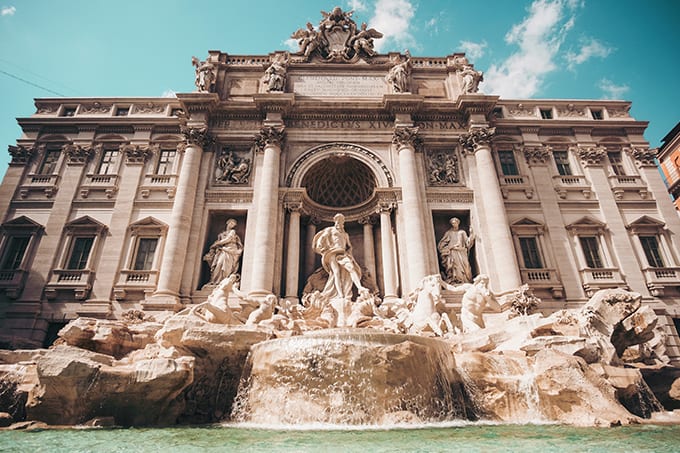
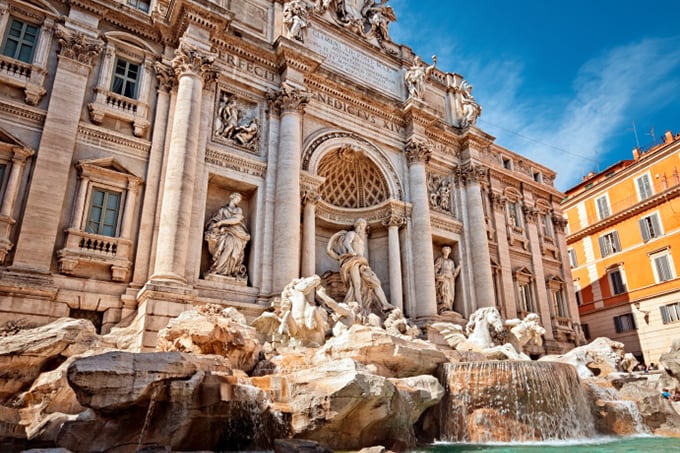
Dating all the way back to 19BC, this Rome water fountain is known to locals as Fontana di Trevi and persists as one of the capital’s most photographed sights. As a stunning example of Baroque art and architecture, it actually was created with a pragmatic purpose in mind - to round off an aqueduct and bring water to the townspeople. Nowadays however, it’s one of Rome’s biggest tourist draws and is always surrounded by people throwing coins into its depths. Constructed by Roman architect Nicola Salvi and completed by Giuseppe Pannini, this Rome fountain pays homage to ancient Roman mythology with the god of the sea Neptune at its centre. Standing astride a shell chariot led by sea horses and flanked by allegorical statues of Abundance and Salubrity, it took nearly three centuries to complete and has changed over the years. However, the Rome Trevi Fountain has never looked better following a recent €2.2 million restoration process.

Trevi Fountain Location

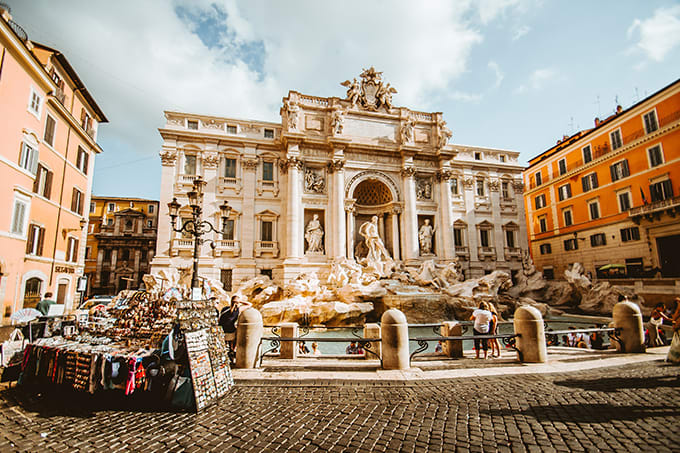
If all roads lead to Rome, then most roads in Rome lead to the Trevi Fountain. Located in the heart of the city nearby the Via Del Tritone, it sits proudly in the centre of Piazza di Trevi. Easily accessible from the Barberini Metro station, it’s also just a few steps from another famous Roman sight: the Spanish Steps.
Best time to visit the Trevi Fountain

As one of Rome’s most popular attractions, the Trevi Fountain is always packed with people daily. For budding photographers seeking an emptier shot and those leery of crowds, it’s best to head here early in the morning to see it in daylight. The Rome fountain completely changes at night, when lights are switched on to illuminate the ivory sculptures for a totally different and atmospheric experience. Wander here after dinner when the crowds have abated for a unique experience after the rest of the tourist pack have retired to their hotels for the night.

Attractions nearby the Trevi Fountain

As one of the most centrally located attractions in Rome, the Trevi Fountain is within walking distance of many iconic landmarks in the capital. The Spanish Steps are the closest by alongside Villa Borghese and its famous gallery a little further along in that direction, while the heading in the opposite direction will take you towards the Pantheon and even the Roman Forum if you’re up for a bit of a walk.
Trevi Fountain Legend

If you’re heading to Trevi Fountain, remember to bring some change. The most popular legend surrounding this famous fountain in Rome dates all the way back to ancient times, granting travellers to the city a safe return to the capital. It’s said that if you turn your back to the fountain and throw a coin with your right hand over your left shoulder, you will be certain to return to Rome in the future. Chances are you’ll spot lots of other tourists doing the same thing and to be honest, who doesn’t want to come back to Rome? Fans of the film Three Coins in the Trevi Fountain may already be aware of the other legend surrounding the fountain, which also builds on the coin-throwing practice. As the title of the film suggests, visitors should throw three coins into the fountain as the first guarantees safe passage, the second a new romance and the third a successful marriage. Even if you’re not particularly superstitious, participating in the harmless tradition of throwing a coin into the fountain actually helps the city. The money from the fountain is collected daily and it is said 3000 Euros are thrown in a day, with proceeds going towards charities that help people in need.
Megan Hills
Rome Travel Expert

Continue reading

Blog

The Shame of Art Vandalism in Rome

Rome is a city of great history, art and culture and any visit should include the stunning attractions, museums and monuments to witness great masterpieces like The Last Judgement at the Sistine Chapel, Bernini’s Alter at St Peter’s Basilica and the She Wolf at the Capitoline Museums. Despite this, there are some who think otherwise and would rather vandalise and deface these historic sites rather than appreciate them. We decided to look at why vandalism is such an issue in Rome and to champion Rome’s edifying heritage and its preservation so that its legacy will live on. Did you know the world Vandal actually stems from the sacking of ancient Rome in 455, when the Vandal Kingdom descended on Rome, ransacking the city and damaging the Temple of Jupiter Optimus Maximus by removing the bronze roof tiles? So you’ll see, vandalism in Rome is, unfortunately, not a 21st century thing. Since the sack of Rome over 1,500 years ago, clearly the issue has been around for centuries – but that doesn’t make it any more acceptable. The mistreatment and disrespect of ancient monuments, landmarks and art around the city proves a continuous battle between the authorities and the criminals. It’s not just the aftermath and clean up which is the difficulty, but the catching them red handed despite best efforts. These vandals are stealthy and secretive and seem to work right under your nose, but strike when you’re not looking. There is a prevalent case of vandalism across the city of Rome. So much so that the Italian Carabinieri, or policemen, have a targeted anti-vandalism patrol to try to control the problem. Unfortunately, it seems that it is unmanageable. Pincio park, the viewpoint in Villa Borghese overlooking Piazza del Popolo, is one of the hot spots for art-crime in the city, where marble statues of famous Italians are defaced with grafitti, or suffer brutal attacks with their noses and other body parts knocked off with hammers. Despite a six-men-strong patrol squads, who were the go 24/7, tens of thousands of euros worth of damage were inflicted on statues and busts across this peaceful pocket of green in over the summer last year alone. It’s not only the Pincio that suffers at the hands of the vandals, the Trevi Fountain has experienced its fair share of damage, being a victim of red dye thrown into its clear waters. Another serious offence was a direct anti-Pope assault vandalising the Holy steps, Scala Sancta – one of the most significant places of pilgrimage in the world. Another violent act of vandalism occured in 2011 when a man attacked one of the 19th century Moor statues in Piazza Navona with a rock causing huge damage. Thankfully the pieces were recovered and it was later repared. If you’re wondering how anyone gets away with this under the recent efforts to crack-down-on-vandalism, increasing surveilance and CCTV; well, they don’t. Anyone caught vandalising will pay for it. Literally. In 2014 a Russian tourist was caught engraving his initial, ‘K’, into one of the Coliseum’s ancient walls, which at over 2000 years old, is undeniably a punishable offence. The tourist in question used a stone to carve a ‘K’ that measuerd 25cm in total, leading to his arrest and a hefty €20,000 fine! Another notorious vandal was Laszlo Toth who gained international recognition for the wrong reasons in 1972. A man of questionable mental stability, Toth was failed geologist who moved to Rome to become known as none other than Jesus Christ himself. He took his new calling so seriously that on the 21st May he visited St Peter’s Basilica and, weilding a hammer, struck Michelangelo’s Pietà with fifteen blows. Thankfully he was wrestled to the ground before he could cause any more damage after breaking Mary’s arm, knocking a chunk off her nose and chipping one of her eyelids. It’s ironic to think that while Rome has such a problem with grafitti now, once it was considered a thing of art. Interestingly a lot of the art that’s now preserved and considered historic art heritage, such as the engravings and paintings at the Coliseum, were actually hand-painted scenes of gladiator fights by the spectators themselves. But while it might have been acceptable over two thousand years ago, times have changed and the law enforcers are on the look out. We must protect all we can of the historic monuments, art works, statues and architecture around the city otherwise who knows what might be left if noone cared. From the second sacking of the city in 455 it’s sad to think not much has changed in terms of hitting Rome where it hurts the hardest. Leave Rome’s beautiful urban landscape and art history alone – everyone will thank them for it in the long run.
Go City Expert
rome travel
Blog

Airport Travel in Rome - Best Transfers

Nothing can deflate the feeling of landing at your vacation destination and feeling lost. What do the words say? Why doesn't your GPS work? Does data really roam? So, let's talk about travel in Rome - getting to and from the airport, the airports themselves, and whether you're better off using public transport or booking a transfer! Travel in Rome - which airport? Rome has two airports: Leonardo da Vinci International Airport and Giovan Battista Pastine International Airport. So, depending on where you're flying from, you'll likely end up in one or the other. Travel in Rome - how far away is each airport from the city? The good news is that both airports are equidistant to the city center, each taking around 30-35 minutes by car. Travel options in to Rome from the airport Before we talk about transfers, which may be your best option as they take all the stress out of your arrival, let's explore alternatives first. Hire a car If you're planning on doing your own driving throughout your vacation, then hiring a car might be your best bet. Both Leonardo da Vinci International Airport and Giovan Battista Pastine International Airport have numerous rental companies based within walking distance. If you're landing at Leonardo da Vinci International Airport, you could rent a vehicle from Hertz, Enterprise, or Europcar, among others. Or, if you're landing in Giovan Battista Pastine International Airport, you could try Firefly, LEASYS, or Thrifty. Prices differ depending on the vehicle you want and the length of time you want it, so it's best you do your own price comparison. That way, you can get the best deal for you! Public transport If you're only staying in Rome for a short period and your baggage is manageable, then you might consider taking public transport to the city center. Both airports have decent connections, so it's more than doable! Public transport from Giovan Battista Pastine International Airport You have two options here. The first is a relatively simple shuttle bus, which will set you back €6, and takes around 35 minutes to get into the city center. The second is via train. From the airport, get the Airlink shuttle to Stazione FS di Ciampino, and then a train to Roma Termini - Rome's central train station. This will take 35 minutes and will set you back €2.70. Public transport from Leonardo da Vinci International Airport Again, you have two options to choose from. The first is another shuttle bus. It's slightly more expensive at €7 and takes around 35 minutes non-stop to the center of Rome. Similarly again, your other option is a train. You can get it straight out of Leonardo da Vinci International Airport; it takes 32 minutes and costs around €3. And now, let's talk about transfers. Travel in Rome - why you should book a transfer from the airport As a stranger in a strange land, it couldn't hurt to get some know-how from the locals. And that's what you'll get in spades if you book an airport transfer. Cab drivers will be able to provide you with local tips and tricks with a vacation twist, so be sure to strike up a conversation and see what tasty gossip nuggets you can mine. Besides, you may have already started celebrating your vacation on the plane, so leaving the driving up to someone else might be the best - and legal - course of action! Suppose you're traveling to a city that doesn't use English as a second language. In that case, it can be difficult to articulate directions, read bus and train timetables, or understand what stops and connections you need to make on any given journey. And, let's be honest, it's the last thing you want to worry about when arriving at your vacation destination! With a transfer, you've already booked the trip, and your driver will know exactly where to take you. Plus, you needn't worry about being overcharged by a sly driver looking to make a quick buck off of a clueless tourist. Unfortunately, it's one of the most common issues you'll run into in Rome, but with a prepaid transfer, there's no need to negotiate! Travel in Rome - types of transfer vehicles from Leonardo da Vinci International Airport Minibus In a group, a minibus is your best bet. They can sit up to 7 people depending on your choice of vehicle, and the baggage area will be yours to own! As it's a private vehicle, you won't have to worry about any other stops on your journey, and this halves the travel time to 35 minutes. Price-wise, you're looking at anything from €30-100 per head, so it's worth researching which works best for you. Car The most stylish choice on this list, a private car is also the most expensive. Like the minibus, your trip to Rome will take around 35 minutes. Unlike the minibus, prices range from €60-400 per person, depending on your vehicle type. That's a lot of dough, but if you've got it, why not flaunt it? Oh, and it's a car, so it can only seat 1-3 people. Travel in Rome - types of transfer vehicles from Giovan Battista Pastine International Airport Minibus Seating 1-7 people, a minibus will set you back anything from €80-280 per person, and takes around 32 minutes. Car A private car from Giovan Battista Pastine International Airport will take around 32 minutes, can seat 1-3 passengers, and will cost anywhere from €60-450 And that's our guide to transfers and travel from the airport in to Rome! Need some vacation inspiration? Check out Go City. With us, you can see all of Rome's best bits when and how you want.
Dom Bewley
Blog

Day trips from Rome

Rome is located just so that it is great for short day trips out of the city in less than two hours travel time. Rome has a whole historic area to be discovered in Ostia and the Appian way as well as other great destinations for the summer, like the Ostia Lido with long sandy beaches and seaside bars. If you’re staying in the city for a bit longer, it’s well worth planning some day trips from Rome to explore more of the area.   Appian Way The Appian Way is one of the most impressive historic ruins in Rome and is one of the earliest stretches of straight roads in Rome, dating back to 312 BC. The road was originally used as a military road which is why it needed to be as straight and strategic as possible, later aiding in the victory of the Second Samnite War. Visitors can still see the ruins and old road still intact – and set in a public park it makes for a great day out and a beautiful spot for a picnic. Address: Via Appia Antica, Roma How to get there: 118 bus from Circo Massimo Metro Station   Ancient Ostia Ostia Antica, or Ancient Ostia, is Rome’s ancient harbor city – before the river moved over the years to where it lies now. Ostia means ‘mouth’ in Latin and was the mouth of the River Tiber. The oldest settlements, most believe, date back to between 396 and 267 BC and it was mainly a military center until the early Imperial period where there is evidence of a theatre and the growth of the Forum, where commerce and trade took place. For anyone interested in history, it’s a fascinating Address: Ostia Antica, 00119, Rome How to get there: Roma-Lido station (by Piramide) and get off at Ostia Antica   Ostia Lido Ostia is the Romans’ go-to summer destination. Just 30kms away from the city center by train, this seaside resort brings both Italian tourists and locals alike to its sandy shores. The town itself is relatively small, with typical Art Deco buildings along the coast and more Fascist-style buildings towards the fringes. During the summer months, it’s a great place to spend the day, bring your towel and enjoy the many seaside restaurants and bars to take you through the day and into the night. If you’re staying for longer there are many B&Bs and hotels to choose from for a short stay. Address: Ostia Lido, Rome How to get there: Roma-Lido station (by Piramide) and get off at Ostia Lido Centro   Castelli Romani The Castelli Romani are a cluster of wine-producing towns southeast of Rome, set in the volcanic area of Colli Albani. It’s a pleasant escape from the hot summer months, with its natural lakes and beautiful mountains with a national park. One of the most popular towns in the area is Frascati – known mostly for its wine! It’s a beautiful hillside town where you can sit out at pavement restaurants, drink wine and indulge in fine food. Address: Frascati, Rome How to get there: Train to Frascati from Termini   Hadrian's Villa Villa Adriana, or Hadrian’s Villa, is one of the most beautiful complexes of Roman ruins you can visit. Situated in Tivoli, you can wander through the classical buildings still standing and exemplary of the times in which they were built. Having been built in 2AD, it is the perfect ancient city with architectural styles from Egypt, Greece, and Rome and its statues and monuments give it the status as a World Heritage Site – and rightly so. Spend the day discovering the beauty of this ancient villa from its thermae, to its theatre, temples, and staterooms. Address: Largo Marguerite Yourcenar, 1, 00010 Tivoli RM How to get there: COTRAL buses to Tivoli from Ponte Mammolo station
Go City Expert
The Colosseum, Roman Forum & Palatine Hill
Vatican Museums and Sistine Chapel - Fast Track & Reserved Entry

Dreaming of that Rome city break?

Sign up to receive top travel tips

Borghese Gallery
Hop-on Hop-off Bus Tour